Showing posts with label Saints who loved Vishnu. Show all posts

Sunday, July 3, 2016

Ramadasu - The Servant Who Built a Temple

In the year 1620, a young baby boy was born to Linganna Mantri and Kamamba in Nelakondapalli village of Khammam dist Taluk (Warangal Division of erstwhile Hyderabad State). The couple  were affluent Telugu Niyogi Brahmins and were quite happy with this blessing of a child. They named him Gopanna.

Gopanna grew up to be a happy child and when he reached the right age he got married to a beautiful young girl called Kamala as per his parents wishes and traditions. Soon with the help of his uncles Madanna and Akkanna who were administrators in the rule of Qutub Shahi Sultan Abul Hassan Tana Shah, Gopanna soon got a job as a Tehsildar of Palvancha Taluk. He immediately went with his now pregnant wife Kamala and settled down in Palavancha and began to discharge his duties with a lot of sincerity and compassion. The people of Palavancha began to rever and respect their new Tehsildar who was very benevolent and compassionate. In time a son was born whom the couple lovingly named Raghuraman.

Time passed and Gopanna came to develop a deep abiding love for Sri Rama, the Prince of Ayodhya and the Incarnation of Lord Vishnu. He began to compose and sing many songs or krithis.

Once there was a jatra or a festival fair at Bhadrachalam and all the people of Palavancha were going to it. Gopanna decided to attend the jatra with his wife and son. He had heard that Bhadrachalam was a very holy place - even the great Pothanna had a vision of Rama here and was asked to write the Ramayana in Telugu. There were many sacred places around it where it was believed that events of Ramayana had taken place. 

When he went there he saw the beautiful idols of Vykuntha Rama, Lakshmana and Sita under a thatched roof. He also saw a pious old lady Pokala Dhamakka, an ardent devotee of Rama, who was protecting the deities and ensuring that they are given the naivedyam daily. She told him that she belonged to a small village of Bhadrireddypalem, close to Bhadrachalam. One night  Sri Rama came in her dream and told her that he was being prayed to by all the rishis and saints in Bhadradri hills. He ordered that she get him out of hiding and keep him safe till the time a devotee comes to build him a temple. Dhamakka went in search of the idols on the hill and found them inside an anthill. Not knowing how to get them out, she carried water from the nearby Godavari water and poured pots and pots of water till the anthill fell away revealing the beautiful idols of her dear lord. She made a small platform with the earth around and stood the idols on it. Then she constructed a thatched roof with leaves and sticks to protect them from the elements.

Sitting at her feet and listening to Dhamakka's story of devotion, Gopanna was moved to
tears. He looked at the old temple on the Bhadradri hill and how dilapitated it was. He couldn't leave the Lord sitting there exposed to the rain and sun. Then and there he decided to move to Bhadradri and personally construct the temple for his dear Lord Rama.

Constructing a temple requires huge wealth which Gopanna didnt have. He went to the people of his Tehsil Palavancha and they responded spontaneously giving whatever they could like gold necklaces, bangles, rings, gold coins, etc, to rebuild this grand temple of Rama. Even though huge amounts of money was collected, Gopanna still ran short. He sat worried wondering how to raise more money when the people of his tehsil came to him with a solution - "Why don't you take the permission of the Tana Shah to use the taxes that you have collected from us. Once our crops are harvested, we shall make do the difference." Gopanna's heart immediately lightened and he immediately sent a letter to Tana Shah seeking his permission to use the collected taxes as a temporary respite. He waited anxiously for Tana Shah's reply. But it did not come. Getting anxious, Gopanna decided to go ahead with his idea since the entire project was getting delayed. 

He thus finished constructing the grand temple for his Rama. But just ass the temple was completed he faced a dilemma. Where could he get a Sudarshana Chakra to be fixed on top of the temple, he wondered. That night as he lay agitating this problem in his mind, he dozed off to sleep. His dear Rama came in his sleep and asked him to go bathe in the river. Gopanna woke up at dawn with Rama's voice ringing in his ear. He went straight to the Godavari and bathed in it with his mind focussing on his dear Rama. And there he found the Sudarshana Chakra in the river! He took it joyously to the temple abd had it installed. Now the temple was complete and from then on the daily poojas for the beautiful idols of  Sita sametha Sri Rama Lakshmana were conducted with great fabn fare and devotion.

Life went on and in all this time Gopanna composed and sang many keerthanas in the praise of his Lord. So pleased was Rama with the physical and musical service being done by this devotee of his that he named Gopanna as Ramadasu. And that is how he came to be known in the region from then on. 

In the meanwhile, back at Golconda from where Tana Shah ruled, Gopanna's letter seeking permission fell into the wrong hands of those who were jealous of his growing popularity. Hence Tana Shah never got the letter. Moreover, he was told that Gopanna had used up all the taxes collected to construct this temple for Rama without permission. Tana Shah was enraged and had Gopanna arrested and summoned to his court.
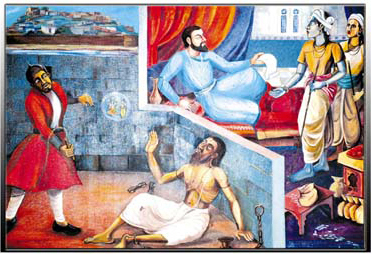

When Gopanna pleaded that he had sent the letter and that he would surely pay up once the harvest was done, Tana Shah didnt believe that Gopanna had sent him any letter. He asked Gopanna, "You took the 6 lakh varahas of taxes to build this temple for this Rama. Do you at least feel any remorse for doing this wrong?" Gopanna smiled and replied, "Everything that is there is this world belongs to my Rama. I have only used his wealth to reconstruct his temple. Why should I feel any remorse?" The answer angered Tana Shah so much that he had him locked up in the Golconda fort. He gave an order that Gopanna was to be released only after he paid up the 6 lakh varahas and promised never to worship Rama or sing any krithis in his praise. He ensured that Gopanna was tortured and kept in constant pain. He wanted that Gopanna's faith in Rama should break and he should accept that what he did was wrong since that wealth belonged to the regime of Tana Shah.


Gopanna was whipped with leather belts and steel balls with spikes. As if that pain was not enough, they applied chilli powder to his wounds so that the pain was increased manifold.  He was either starved or given rotten food and dirty water. He relentlessly sang innumerable keerthanas expressing grief, anger, pleading with Rama to save him. He chanted and wrote Ramas name on the walls of the dungeon. He suffered at the hands of his tormentors for 12 long years in the dungeon of Golconda fort. Yet Gopanna's faith in his Rama and Sita only got stronger. 

Then one late night as Tana Shah rested in his inner apartments in his palace, he was woken up by two young boys. They said, "We are Ramoji Lakshmoji. Here are more than 6 lakh varahas. Give us a receipt for it and release Gopanna immediately." Saying so, the beautiful boys with a strange effulgence threw a bag of gold coins that was more than the debt to be paid. They took the receipt, gave it to the Jailer of Golconda Fort and had Gopanna released. However, when Gopanna came out they were nowhere to be seen. Not knowing who had paid off his debt, Gopanna went to Tana Shah to find out the answer to this tantalising question. He found Tana Shah still contemplating on who the two boys were who had come into his inner chambers despite the tight security. He could not take his mind of their mesmerising beauty and radiance. Seeing Gopanna, he narrated the events of the night. In a flash, Gopanna understood that it was his dear Rama and Lakshmana who came to pay for his release. He was completely grief stricken that he had missed having a darshan of the Lord while Tana Shah a non believer had seen andd heard him at close quarters. What mystery was this? Gopanna was inconsolable at the lost opportunity and overcome with emotion that his Lord had come just to release him. 

He picked up one of the coins touched by his Rama himself- and to his utter surprise he found that it had the unique mudra or insignia of Rama himself !! Astounded, Tana Shah realised that it was indeed Rama and Lakshmana who had come that night!! They really did exist! From then on Tana Shah became a devout believer and gave away all the gold mohurs that Rama had given to release Gopanna, to the Bhadrachalam temple. Even today, 2 of these coins are kept at the Bhadrachalam temple. After this year, every year on Rama Navami day, Tana Shah would send pearls and expensive gifts to the Lord -  a practise continued till this day by the present day government.

Desolate in his grief, Gopanna asked his Rama again and again why he was denied the  darshan of his Lord when he was so close. He became so miserable that he decided to end his life. Then Sri Rama came in his dream and explained - In his previous birth as a young man Gopanna had imprisoned a Ramachilaka - a parrot that recited the name of Rama. The parrot was miserable and afraid locked in the cage. He would laugh every time the parrot chanted the name of Rama. He kept it caged and enjoyed its predicament for 12 days after which he relented and set the parrot free. Since he had tortured and frightened a living being that was defenceless, that too one that kept chanting Rama's name, for 12 days, in this birth he had to suffer pain and torture for 12 years while Tana Shah made fun of his keerthanas. Rama then went on to give Ramadasu his darshan along with Devi Sita and Lakshmana. He blessed Ramadasu that at the end of this life he would attain moksham and reach Vaikuntam

Gopanna went back to Bhadrachalam and spent time taking care of his Rama and Sita and discharging his duties in managing the temple till at the age of 60 he died and attained moksham. The ardent devotee who was impatient to be with his dear Lord was finally taken by Rama who was even much more anxious to have his child near him. Gopanna became eternal as Ramadasu and even today his haunting keerthanas plead, cajole, scold, love, question agitate and so much more with Rama.  He lives even today in the hills of Bhadradri, the abode of his dear Rama Sita and Lakshmana singing his beautiful keerthanas.

Saturday, March 6, 2010

Goswami Tulasidas - Composer of Ramacharitamanas


This is a very touching story of a small boy called Rambola, who became a great devotee of Rama and wrote the entire Ramayana in Hindi.

Tulasi as he was later commonly known was born in 1554 in the Shravan (August) month  on Shukla Saptami in Rajapur, Uttar Pradesh. His father’s name was Atmaram Dubey and mother was Hulasibai. They were a very god-fearing and conservative couple.

As soon as Rambola was born, to everyone’s astonishment, the baby had 32 teeth intact!! Also, instead of crying like all other babies, he chanted “Ram, Ram”!! Hence his parents named him Rambola. His father was a very superstitious man. “A new born baby chanting Rama’s name, is not natural. This is sure to bring some misfortune”, he thought. Rambola’s mother too was sad by the strangeness of her baby. Expecting that the father may cause harm to the baby, mother Hulasi, sent away her baby with her servant Muniya. Muniya took the baby to her village called Haripur and lovingly brought up this baby. As luck would have it, Rambola’s mother soon died within a few days of his birth, confirming Atmaram’s worst fears.

Sadly, soon Muniya too died and the young child Rambola was orphaned. He brought up by the people of the village. He lived in the Hanuman temple just outside the village. Worshippers would bring offerings of fruits and sweets for the Lord and would also bring milk and food for the child.  So Rambola grew up on the affectionate offerings that the village people made to Lord Hanuman.

Some years passed. When Rambola was a young boy of about  5 years or so, a great saint Swami Naraharidasji came to the village. Swamiji stayed in the village and recited the Valmiki Ramayana at the Hanuman temple. The little boy was totally mesmerized by the epic work and thus Rama touched his soul!

Rambola sat right in the front row during all the discourses. At the end of the entire Ramayana discourse, Swami Naraharidas ji called Rambola to him and asked , “Son who are you?  I have been observing you all these days. You have sat through the entire Ramayana discourse and I can see that you have been moved by it!” Rambola replied with tears in his eyes, “Swami, I am Rambola. I don’t have any parents and I live here in this temple. Hanumanji takes care of all my needs”. Swamiji further smiled and asked, “Is that so? Who gave you this name, son?” Rambola replied, “Lord Ram himself gave me this name when I was born. They say that as soon as I was born, I chanted Rama’s name.” “Oh! So what do you do now?” asked Swamiji. “Well, I chant Rama’s name sometimes. But I also want to learn about Rama, Swamiji,” said a tearful Rambola. Swamiji immediately took the young child along with him to his ashram at Sookar. There he initiated Rambola into the devotion of Rama by teaching him to chant the Rama nama. He also recited the Ramayana to him many times. Soon the bright child learnt the scriptures, Vedas and all there was to learn very quickly. Since he was given the responsibility of taking care of Swamiji’s Tulasi garden, swamiji named him Tulasidas, and the name stuck!

As he years rolled by, Tulasidas, became absorbed in chanting Rama’s name all the time and tending to his Tulasi garden.  He also traveled with Swamiji to all the places and helped him all the while listening to swamiji’s discourses. He soon began to write small couplets in local Hindi dialect.

As time passed, with swamiji’s blessings, Tulasidas was married to a very beautiful girl called Ratnavali from a nearby village. Ratna’s father was a very rich business man. Since Tulasidas now needed a source of income, his father-in-law setup a shop for him to manage at Sookar itself. Days passed by very happily for the newly wedded couple. However, it became embarrassingly apparent to everyone and to Ratna that, Tulasidas could not stay without seeing Ratnavali even for a few moments. He would follow her to the ghat when she went to wash clothes and fetch water! Or would leave the shop unattended just to come and see her. It disturbed Ratnavali that her husband was so besotted by her. She was often upset that her husband, a great scholar, who had till then been such a devout Rama devotee had now all but forgotten Rama in his love for her!

One day, when Tulasidas had gone to the market to purchase goods for his shop, Ratnavali’s brother suddenly arrived at their home. He had come to take Ratnavali home for the annual festival. Besides, their father too was unwell and wanted urgently to see Ratna. It was obvious that Ratna had not visited her parents home in a long time since Tulasidas never gave her permission to go. Ratna asked her brother to wait since Tulasidas was not at home. Ratna’s brother suggested that they leave a note for Tulasidas and leave immediately, since a storm was brewing and they had to cross the river to go home. Ratna agreed reluctantly and left a note for Tulasidas, packed her clothes and left for her parents home with her brother.

As night came, Tulasidas reached home to a darkening sky and heavy rains. He entered his home to find it pitch dark and not a soul in sight. He called out to Ratna but there was no answer. Suddenly his eyes fell on the note left by Ratna. As he read that Ratna had left for her parents’ home and would be away for a week, he broke out in cold sweat! How could he bear to be without her for a week? Dazed by sorrow, he went to the river ghat in the hope that he could be ferried across. But the river was already in spate and no boat was in sight. In the darkness, Tulasidas saw something floating by. It looked like a log of wood. He jumped into the water, held on to the log and swam across to the other end, against the current. Only when he left the log, he looked back to find that it was actually a dead body that had come floating down from the burial ghat! Focussed as his mind was on meeting Ratna, this didn’t shock him. He walked to Ratna’s house. It was already late night and the household had retired for the night. Not knowing what to do, he went around the back of the house and stood under Ratna’s balcony. He saw a rope hanging down. He caught it and climbed up to the balcony. He knocked on the door. As Ratna opened the door she saw her exhausted husband standing at her doorstep, completely drenched with a snake in his hand. Tulasidas had in his anxiety to reach his wife, mistaken the snake for a rope! She was so shocked, she asked, “How did you come in this storm? Why did you bother to come – I would have come back in a week isn’t it? I had left a note for you.” Tulasidas, stood there petrified that his wife could stay away for a week. He answered, “Yes I saw that note. But Ratna, how could I stay away from you for such a long time? You shouldn’t have left me like that. That’s why I decided to come and stay here with you. I braved the storm and crossed the river on a dead body to be able to see you! I love you so much!” A shocked Ratna was speechless. Such madness! She turned around in anger and lashed out at Tulasidas, “ What is this madness that you have? So much attachment just for this bundle of bones and flesh? If only you had shown even a part of this madness and devotion to your Rama then you would have become immortal by now!”  The harsh words pierced Tulasidas’s heart and he stood shell-shocked. For a moment, it was like he had turned to stone. Then he just quietly turned around and went out of the house into the raging night , never to return.

Tulasidas abandoned his home and for the next fourteen years, he wandered as an ascetic, from one sacred place of  pilgrimage to another. While he was at Kashi, everyday after his ablutions, Tulasidas used to pour the water from his pot at the foot of a tree. It so happened that there was a spirit that lived in that tree. Pleased with this kind act of Tulasidas, one day, the spirit asked Tulasidas to seek a boon from him.  Tulasidas said with tears in his eyes, “Sir, give me the darshan of my Rama”. The spirit then said, “I don’t have that power. But I can tell you how to get the darshan. Ask this boon of Lord Hanuman. He comes in the guise of an old leper to listen to the Ramayan at the Hanuman temple everyday. You will recognize him easily. He will be the first to come and last to go” Overjoyed by this, Tulasidas, thanked the spirit and ran to the temple. That evening, as predicted, an old leper came and sat down to listen to the Ramayan discourse. Throughout the discourse, Tulasidas, did not take his eyes off the leper. Much after the discourse was over, the leper got up slowly and painfully to leave. Tulasidas ran and fell at his feet and cried, “Master, I know who you are! I have recognized you. Please give me darshan of my lord Rama!” The leper cringed and said, “Son, what are you talking? Have you mistaken me for someone else? I am only a poor leper. Don’t touch me!” When Tulasidas held on to his feet even more tightly and cried bitterly, then a smiling Hanuman showed himself and blessed Tulasidas, “I am pleased with your devotion. Come to Chitrakoot, where you shall have darshan of your Lord”. Overjoyed at the prospect of being able to see Rama, Tulasidas immediately rushed to Chitrakoot where he waited for that beautiful moment.

One day at Chitrakoot, while he was doing parikrama at Kaamadgiri (a hill in Chitrakoot where Lord Rama had stayed), he saw 2 very handsome young men riding towards him, on horseback. One was dark complexioned and another was fair. He was mesmerized by their beauty and kept looking as they passed by, without realizing that he was actually seeing his chosen idol. When Hanuman told him later, of what he had missed, he was very upset. He pleaded with Hanuman for another opportunity. Hanuman promised him that he would see the Lord again. So Tulasidas  began his chanting of Rama nama all over again, this time with greater fervour.

A few days later, one morning as Tulasidas sat at the Ram ghat on the banks of the Mandakini river  rubbing sandalwood, two young boys came to him. They very beautiful to look at. The darker of the boys smiled at Tulasidas and requested, “Swamiji, please apply tilak on our foreheads.” Tulasidas asked them to wait a bit, ground some more fresh sandalwood and chanting all the while, he offered  the paste to the boys.  The dark boy applied the paste on His own forehead, and  his brother’s. Then he took some more paste and applied it to Tulasidas’ forehead. Tulasidas was mesmerized by the boy’s touch and beauty. As he watched transfixed, Hanuman in the form of a parrot on a nearby mango tree, sang this popular doha pointing out to Tulasidas, that these two boys were none other than his Rama & Lakshmana
चित्रकूट के घाट पर भइ सन्तन की भीर |
तुलसिदास चन्दन घिसें तिलक देत रघुबीर ||

Immediately Tulasidas cried out and fell at Rama’s feet. His heart filled with Rama, Tulasidas spent a few more days at Chitrakoot chanting and praying.

One night, Lord Siva came in his dream and asked him to write the Ramayana in the local language.  The next morning, Tulasidas, left for Ayodhya to pay homage to the lord. As he sat in meditation there , the whole Ramacharitamanas came to his mind as an inspiration. Over the next 2 years and more, he wrote the 7 chapters of the Ramcharitamanas (in Maithili and Avadhi language) while traveling between Ayodhya, Kashi and Chitrakoot.

Soon the Ramacharitamanas in its simple poetic beauty, charmed its way into the hearts of the people. However, some learned scholars objected to the Ramayana being recited in any other language other than Sanskrit. With the aim of testing this new scripture, Ramcharitamanas was put at the top of all scriptures in the temple of Shri Vishvanath in Kashi. The door was closed for the night. Early the next day, when the temple door was opened, to everyone’s astonishment and joy, Ramcharitamanas was found lying at the bottom of all scriptures. Its first page had the signature of Lord Vishvanath Himself- "सत्यं शिवं सुन्दरं" (Satyam Shivam Sundaram). This incident forced everyone to accept the greatness of this epic and of Swami Tulasidas.


After this many events happened in Tulasidas’ life, that proved that Rama was a constant presence in his life. 

Once a gang of thieves heard that Tulasidas had some wealth and that he lived alone. So in the stealth of night, they came with the objective of taking it all away. They assumed that there would be little or no resistance. To their shock despite repeated efforts over many nights, they just could not enter his hut. They found 2 princes with bow and arrow were guarding the hut from all sides. They kept moving wherever the thieves moved! The next morning they came and fell at Tulasidas’ feet and asked to be forgiven. Tulasidas wept to think of his Lord working to protect him. He immediately gave away whatever little wealth he had.

While he was at Varanasi, one day a beggar came to Tulasidas’s home and pleaded, “Swami, I am a murderer. No one is willing to give me any food. I am sorry for my act. For the love of Rama, please forgive me and give me some food.” Tulasidas called the beggar in, helped him have a wash, and gave him the sacred food that had been made for Rama. Tulasidas believed that since the man had repented, and he had taken the sacred food of Rama, his sin had been washed away. The Brahmins of Varanasi were very upset with this. They demanded, “How can such a serious sin as murder be washed away by just eating your food. No! no! We shall only believe you if the stone bull at the Shiva temple eats grass from his hands. And lo! When the man gave grass to the stone bull, it actually ate the grass! All the men who had objected now apologized for not trusting Tulasidas and his bhakthi.

Once Tulasidas brought back to life the dead husband of  a woman. The Moghul emperor heard of this and ordered Tulasidas to be brought to his court. When Tulasidas came, he ordered him to show him a miracle else he would put him in jail. Tulasidas pleaded, “I don’t have any powers. I know only how to chant my Rama’s name.” But the emperor would not leave him. Not knowing what to do, Tulasidas prayed to Hanuman to help. Suddenly, the palace began filling with monkeys of all shapes, colours and sizes. The emperor got very frightened and begged forgiveness!

Such was the greatness and humility of this great saint. Sant Tulasidas died at the age of 126 in Varanasi. In his lifetime, he wrote 12 major works. Other than Ramacharitamanas, the other important work is Vinaya Patrika.  Other scriptures composed by him were Kavitaavali, Hanumaan Baahuk, VrihadBarwai Ramayana, LaghuBarwai Ramayana, JaanakiMangal, PaarvatiMangal, Dohaavali, VairaagyaSandiipanii, Tulsi DohaaShatak, Hanumaan Chaalisaa, Geetaavali Ramayana, Krishna Geetaavali,

He is considered by many as the incarnation of Valmiki since it was Lord Shiva’s desire that Valmiki Ramayana be written in the local language.  His life was one of devotion, love & implicit faith in Rama – his chosen idol.

Monday, February 22, 2010

Kodai - A little girl in love with Ranga

This is a beautiful story of a small girl who decided that she would marry only Lord Krishna and no one else.

In a small town called Srivilliputur, near the city of Madurai, in Tamil Nadu, lived a very pious devotee of Lord Sri Krishna. His name was Vishnuchitta. He loved Lord Krishna deeply as a mother would love her child. He would spend the whole day working, yet thinking of Krishna and his pranks; of how Yashoda would have managed and taken care of Him. Thinking of Krishna, or chanting and singing The Lord’s names, Vishnuchitta would spend a good part of the day, tending to a beautiful garden of flowering plants – watering them, cutting their branches, keeping the garden clean etc. Then he would gather the flowers and tulasi  for the day and make a beautiful garland for the Lord Ranganatha and give it at the temple at Srirangam.  All the while, his mind would be filled with Krishna and stories of his life.

Vishnuchitta was not a very learned man – he had studied some shastras but was not a great scholar. However, his devotion to Krishna filled all his time, space and mind. So, while his hands worked at the plants, flowers  & the garden, his mind constantly thought of the baby Krishna and all his tales. He would constantly be chanting his name. He thought of himself as Yashoda, Krishna’s mother and cherished Krishna as his own child. In such a devout manner, the days passed happily for Vishnuchitta.

One day while plucking the flowers and tulasi for the garland, Vishnuchitta heard the cry of a small baby. He moved towards the sound and found a beautiful baby girl, kicking and smiling, under the tulasi plant. The baby had a divine quality about her and was beautiful. Vishnuchitta  had no child of his own so he took the baby into his hut. Though he was pleased to have this child for his own, he wondered how he would bring up a small baby. However, the worry vanished in an instant when he realized that Krishna would take care of all his problems!! He thought to himself,  Krishna has sent this child to me -  he will take care”. Vishnuchitta named the baby “Goda – meaning “from the earth”. In Tamil, he lovingly called her Kodai.

Every day, Vishnuchitta usually ate only the offerings or prasadam given at the  Ranganatha temple at Srirangam.  And this is what Kodai  too grew up on. Throughout the day, while he worked, Vishnuchitta kept telling Kodai, stories and pranks of little  Krishna. Over a period of time, the pious atmosphere of the home, the constant service of making garlands for the lord, listening to his stories, singing his names -  all became deeply embedded in Kodai’s mind. And time flew by.

As a young girl of now about 6, Kodai, was deeply attracted to Krishna. Like her father, she too wove garlands for him and thought of him all the time.  Her love for Krishna became such a force that filled all her being. She desired to marry only Lord Rangantha.  This thought soon became a firm resolve and  she could think of nothing else.

In those days, girls were married away at a very young age. Hence, as she grew a little older, Vishnuchitta now began thinking of finding a suitable husband for his daughter. He called Kodai and gently patting her head, asked her, “Its time that I do my duty as your father and find you a suitable husband. What kind of person would you like to marry, my child?”. Kodai, very clearly said, “Ill marry only Lord Rangatha and no mortal man shall touch me”. Vishnuchitta was unsure if his child understood the meaning of what she was saying. He worried for a moment – how was he to get the Lord to marry this little child of his? “She is just a child and maybe this is just a childish fancy. She will grow out of it. Can this really happen?’  The next moment he decided, “Anyhow, it is the Lord himself who has put this desire in Kodai’s heart. So he himself will show the way”.

Thus happy to let the Lord take care of his problems, Vishnuchitta spent his days happily in service to the Lord and in delightfully watching his daughter grow.

One day, she saw the garland made by her father lying in the basket. She thought, “If I wear this garland and put it back in the basket, then the priest in the temple will put this garland for the Lord. It will be as if Lord Ranganatha and I have exchanged garlands. Isn’t that one of the most important rituals in the wedding ceremony?” She quietly took the garland and wore it. As she looked into the well and saw her beautiful reflection in the water, she admired the garland. It seemed to her that  it would indeed look even more beautiful on the Lord Rangantha. She quietly put it back into the basket  to be taken to the temple. Vishnuchitta  took the basket to the temple and offered the garland to the Lord, unaware that his daughter had already worn the garland.

While Vishnuchiita went to the temple, Kodai waiting excitedly for the news that the Lord had accepted her. She began to imagine herself garlanding Lord Rangantha  and marrying him.

At the temple, in the meanwhile, Vishnuchitta offered the garland to the priest. As the priest was about to offer it to the Lord, he found a long strand of Kodai’s hair in it and immediately understood that some girl had worn it. He became deeply disturbed and gave the garland back to Vishnuchitta saying, “ How could you have brought a used garland for the Lord? You have delayed the Pooja now and the Lord will have to wait for a new garland.” Concerned that  the daily pooja for the Lord was delayed because of him, and that his beloved Kodai had committed such a sin, Vishnuchitta ran back home in tears. Hearing from her father about his sorrow, Andal’s heart filled with grief – “If my garland is not fit enough to be accepted, then surely, Lord Ranganatha will not accept me as his wife!” He quickly wove another garland, ran back to the temple. Only this time, when Vishnuchitta entered the temple with the new garland in his hands, the lord would not accept it. Instead He spoke to him and said, “Why have you not brought me the garland worn by my Kodai. It has the fragrance of her love that makes it special. Bring that garland and offer it to me! I don’t want any other garland!”  Stunned by this reply from the Lord but thrilled to hear that the Lord had accepted his daughter’s devotion, Vishnuchitta rushed back. He  hugged his child and shed tears of joy. He gave her a new name – “Andal- one who rule the heart of The Lord”. When Kodai heard that The Lord had asked for her garland, her joy knew no bounds. It was an indication to her, that he had accepted her love for him. More importantly, she realized that he too loved her in return -  her happiness knew no bounds.

That night Vishnuchitta had a dream  - The Lord Rangantha Himself came in his dream and asked Vishnuchitta to prepare his daughter to be His bride. He would marry her the next day. He told Vishnuchitta, “I shall send a palanquin for my Kodai along with all the finery fit for a divine bride. All the necessary arrangements shall be made. I shall personally come to marry her.”  Vishnuchitta startled, woke up from his dream excited and worried all at the same time. He was thrilled that the lord himself had accepted his child and her desire to marry him. But as a father, he was equally concerned – how was he to get all the finery required to dress his precious child fit to be the bride of Lord Ranganatha himself?

He need not have worried at all! The lord had made all the arrangements! The same night Lord Ranganatha also came in the dream of the head priest of the temple at  Srirangam . The Lord gave him Instructions, “I wish to marry Kodai, the daughter of my devotee, Vishnuchitta. So, go to Srivilliputtur tomorrow, with a palanquin and all finery fit for my bride. Go to the house of Vishnuchitta and give him all the gifts on my behalf. where I shall marry her.”

The priest and scores of attendants woke up the next morning and made haste to Srivilliputtur with all the wedding finery and a bedecked palanquin fit for a queen. When they reached the house of Vishnuchitta, a poor Brahmin, his joy knew no bounds.

Meanwhile, Kodai too had dreamt the previous night of her marriage with the Lord and she became excited and shy at the same time.

With all the finery sent by Lord Ranganatha to Vishnuchitta, Kodai was dressed to be Lord Ranganatha’s bride. As in the dream, Lord Ranganatha himself arrived at their doorstep. No one except Vishnuchitta and Kodai knew who he was. All people of Srivilliputtur were wonderstruck – “How had this poor Brahmin managed to strike such a princely alliance for his child? How did this mad child who kept blabbering all the time about Ranganatha coming in to marry her, find such a stroke of good luck and get  such a handsome and rich husband?”  The Gods attended the wedding as ordinary mortals. Goddess Parvati, Lord Ranganatha’s sister, herself came with the bridal saree and helped Kodai wear it. She brought her to the marriage pandal and seated her beside her Lord. The shy Kodai was breathless as she saw each and every part of her dream coming alive including the decorations at the wedding function, the sweets being served, the music being played!!! Everything! Everything was exactly as she had dreamt! What a wonder!

Soon the wedding over, Kodai climbed into the palanquin ready to leave for Srirangam. The Lord walked alongside it in long strides and poor Vishnuvitta made haste to catch up with them. However, he was soon left a little behind the eye-catching procession. The whole of Srivilliputtur came out to watch this grand spectacle of a young girl whose dream to marry the lord Ranganatha was about to come true! They all walked behind the palanquin. It was a fine procession that soon reached Srirangam.

As the procession reached the temple sanctum sanctorum at Srirangam, Lord Rangatha as the bridegroom, walked in and merged with the idol. Kodai was dumbstruck! What should she do? In a flash it occurred to her that now she was his wife and had every right to be with him! She gave a quick smile and climbed onto the idol of Ranganatha to sit beside him. In a blinding flash of light, she disappeared. A few minutes later a panting Vishnuchitta arrived at the inner precincts of the temple only to find that neither his beloved daughter nor his new Son-in-law were anywhere to be seen. In fact if all this talk around him were true he may never see them again!! His eyes welled up with tears.  He was not sure whether the tears flowing down his cheeks were those of joy or sorrow – The joy of becoming the father-in-law of the Lord or the sorrow of losing  his daughter forever. As his thoughts raced from one emotion to another and he stood with tear stained cheeks and folded hands, he heard the voice of the lord. “Vishnuchitta, don’t feel sad. Your daughter is with me and shall always be by my side. And you too shall always be close to me as the father of my Kodai and also as my special devotee. Go back to Srivilliputtur and build a temple for both of us and lay down the ceremonies to be performed as they were today. Spend the rest of your days in making my flower garlands and singing my name. You too shall soon reach me.”

Vishnuchitta returned home to Srivilliputtur with joy in his heart. He built the temple of Lord Ranganatha at Srivilliputtur and spent the rest of his days singing the glories of the Lord.
In her short life of 6 years, Kodai or Andal, sang 2 great works - 

  1. Tiruppavai – a garland of 30 songs, where she identifies herself with the Gopis of Vrindavan and for 30 days keeps the Katyayani vratam to reach Krishna

  1. Nachiyaar Thirumozhi – a set of 143 verses in which an eager & restless Andal tries various methods by which she can attain union with Krishna. Vaaranam Aiyaram, a part of this, is a set of verses where Andal vividly describes her marriage with the Lord.

Wednesday, February 17, 2010

Stories about Hari's devotees...

India is a land of action or karma, where many saints have taken birth through the ages, to help apsirants personalise their spiritual journey and evolve. Listening to ther life stories, helps deepen faith and realise your personal God.


This series is an attempt to share the stories about some of these devotees and emotionally getting connected with them. It is particularly meant for children in whose hearts it is very easy to sow the seeds of love and devotion.


I have chosen devotees of Vishnu right now, since it is easy for me to connect with them due to my own faith. It helps me to get involved and write with passion